Bachelor or Master thesis - Drought projections for Switzerland
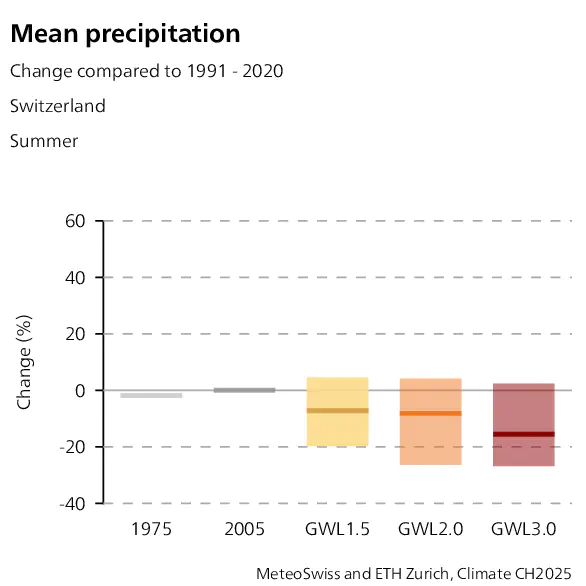 Niederschlagsveränderung (Sommer: Juni-August) für verschiedene Erwärmungsszenarien (1.5, 2.0, und 3.0 Grad Celsius Globale Temperaturzunahme). Quelle: CH2025 Meteoschweiz Web-Atlas
Context
Useful drought projections have to go beyond analysing trends in precipitation. The timing of precipitation events, trends in temperature and incoming solar radiation, and changes in snow accumulation and snowmelt jointly determine drought impacts. These processes are especially important when considering the effects of drought on forests and grasslands.
The latest climate change scenarios for Switzerland (CH2025) provide high-resolution projections of the climate conditions that shape future droughts. This thesis will use these projections to investigate how climate heating changes the frequency and magnitude of drought across Switzerland.
Aim
The aim of this thesis is to evaluate the CH2025 climate projections for trends in drought, quantified using the potential cumulative water deficit (PCWD). PCWD is a simple metric that combines the primary climatic factors driving vegetation water stress and productivity declines during drought.
Methods
You will work with daily climate simulation outputs from CH2025 at 1 km spatial resolution. You will calculate PCWD and analyse how it changes relative to the modern reference climate. The resulting maps and time series will reveal where, when, and by how much drought conditions are projected to change in Switzerland.
Through this work, you will contribute to a better understanding of how climate heating affects drought risk for Swiss ecosystems.
Requirements
- The student is motivated to work with large datasets and puts an emphasis on producing reproducible analyses and reusable code
- Experience working with climate model outputs, NetCDF data, raster data in R or other data science tools are an advantage.
- The student writes the thesis in English.
Supervision
Prof. Benjamin Stocker